
BioLoop does not compete as only a vertical farm or only a waste project. It combines both into a new, smaller market space.
Strategic fit
BioLoop became more competitive the moment the idea became more disciplined.
Judges reward entries that are easy to explain, believable to execute, and clearly differentiated. The refined BioLoop concept scores better because it narrows the offer, strengthens the buyer story, and creates a cleaner strategy narrative across value innovation, feasibility, and presentation.
Sharper value curve
Clear first buyer
Competition-ready story
What judges value
BioLoop is now aligned to the five areas that matter most in a competition setting.
The category language matters because it keeps the site professional and evaluation-ready. Each section below is written to answer the question a judge is most likely to ask.
The first customer is clear, the pain point is visible, and the replication logic extends naturally to similar towns.
The municipal service contract is the anchor. Produce and biochar improve the model instead of carrying it alone.
The design is based on commercially recognizable building blocks and a phased pilot instead of speculative full-scale integration.
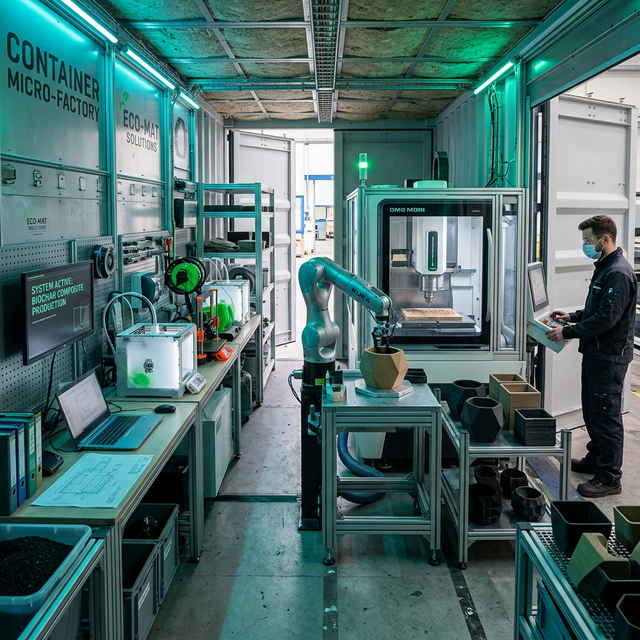
Two containers, one town, one pilot, and one circular story are easier to communicate than a broad resilience ecosystem.
Why the refinement works
The BioLoop pitch improved because it corrected the exact weaknesses judges would have noticed.
The earlier resilience-hub framing showed strong research and systems thinking, but it diluted the venture’s core value proposition. The revised BioLoop concept fixes that problem directly.
One coherent innovation replaces a cluster of semi-related businesses.
BioLoop no longer asks judges to believe in a farm, a carbon-removal system, a training business, a mental-health platform, and an authenticity network at the same time.
Students can credibly pitch a pilot product, not a cross-sector holding company.
The refined version keeps the product within a scope that is easier to prototype, model, discuss, and benchmark against real-world analogs.
A single beachhead customer sharpens the market story.
When the buyer is a rural municipality, the business case becomes easier to explain than a model serving grocers, schools, consumers, clinics, and digital trust platforms simultaneously.
Strategy canvas
BioLoop changes the value curve by combining local food, waste diversion, and energy relevance.
The table below uses the municipality-first factors that matter most for this version of the concept. The goal is not to claim perfection. It is to show where BioLoop creates a distinct profile that existing alternatives do not match.
| Competitive factor | BioLoop | Community gardens | Vertical farms | WTE plants | Imported produce |
|---|---|---|---|---|---|
| Affordability for small towns | 7 | 9 | 3 | 1 | 8 |
| Deployment speed and permit simplicity | 7 | 8 | 5 | 2 | 9 |
| Year-round local produce | 8 | 2 | 9 | 1 | 9 |
| Waste-to-value diversion | 8 | 3 | 2 | 9 | 1 |
| Net climate benefit | 9 | 6 | 5 | 6 | 2 |
| Local energy co-benefit | 8 | 1 | 2 | 8 | 1 |
| Local jobs and skills | 8 | 3 | 5 | 6 | 2 |
| Replicable modular scaling | 9 | 4 | 7 | 2 | 10 |
BioLoop does not try to beat every alternative on every single factor. Its strength is that it combines scores that rarely appear together in one offering: local food, local waste utilization, energy co-benefit, climate relevance, and modular replication.
ERRC grid
BioLoop becomes a breakthrough concept because it changes the trade-offs, not because it adds more features.
The most useful version of the framework is the simplest one. BioLoop does not win by claiming it does everything. It wins by showing what it intentionally eliminates, reduces, raises, and creates.
Diffuse scope and unclear market targeting
- Remove unrelated business lines from the first-year pitch.
- Eliminate the need to explain multiple customer segments in one video.
- Stop framing the venture as a giant all-at-once resilience complex.
Capital shock and execution complexity
- Reduce the size of the initial build to two containers and a single public site.
- Reduce dependency on multiple regulatory domains at the same time.
- Reduce the storytelling burden in a five-minute presentation format.
Clarity, feasibility, and buyer confidence
- Raise the quality of the value proposition by centering one buyer and one operating model.
- Raise perceived feasibility through modular design and phased deployment.
- Raise the visibility of local impact through food, heat, and diversion metrics.
A new municipal category: food, waste, and heat in one compact product
- Create a product that sits between local agriculture, waste infrastructure, and climate resilience.
- Create a procurement story towns can understand as a service-backed MicroHub deployment.
- Create a circular demonstration asset that is both operational and presentation-friendly.
Noncustomer logic
The opportunity grows because BioLoop speaks to groups that current categories underserve.
High-impact opportunities emerge when a concept reaches people who are not well served by the current market boundaries. BioLoop’s refined positioning opens that door more clearly than the original RRH framing.
Towns that want organics diversion but do not want a full utility-scale project
These communities need a smaller, more approachable entry point. BioLoop gives them a visible pilot that does not look like a giant plant.
Leaders who like sustainability goals but distrust overcomplicated innovation pitches
The refined BioLoop story lowers skepticism because it reads like infrastructure with outcomes, not a stack of loosely connected aspirations.
Remote or under-resourced communities that need resilience with local control
Once the municipal model is proven, the same logic can extend to schools, tribal communities, industrial parks, and global rural contexts that need compact local production and resource recovery.
The strategy page makes one point above all others: BioLoop is more persuasive because it is more focused.
With the competitive logic clarified, the next question becomes execution. That is where the municipality launch plan and year-one pilot structure matter most.