Municipal circular infrastructure

A modular MicroHub that turns local biomass into food, heat, and durable carbon storage.

BioLoop is positioned as a focused infrastructure product for rural municipalities: a two-container system that pairs controlled-environment agriculture with biomass-to-biochar conversion, then packages the results into a clear public-sector service model.

Pilot-ready scope Municipality-first buyer Measured circular outputs
2 Core containers

One farm module plus one biochar-and-heat module.

1 Primary buyer

Rural municipalities anchor the first customer story.

3 Core outputs

Greens, heat, and biochar create the operating loop.

12 Month MVP

A measured first-year pilot keeps execution credible.

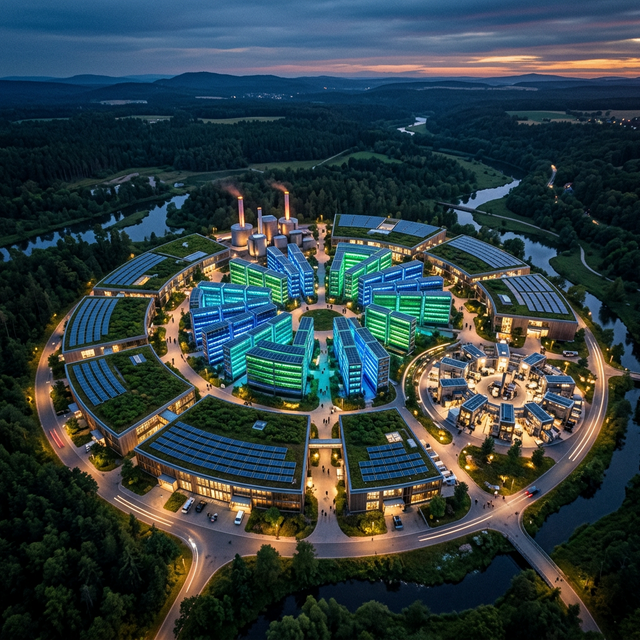
BioLoop system render
Deployment story Procurement-ready pilot narrative

What BioLoop sells first

A standardized municipal MicroHub service: one site, one operating model, one reporting dashboard, and one concrete reason for a town to say yes.

Designed for municipal pilots rural resilience organics diversion local food access carbon reporting
Why it matters

Three pressures create the opening BioLoop is designed to address.

The opportunity becomes stronger when the idea stays disciplined. BioLoop is framed around highly visible municipal pain points rather than trying to solve every community problem at once.

Food resilience

Rural communities need dependable access to fresh local produce.

Long supply chains make small towns vulnerable to delays, price pressure, and inconsistent freshness. BioLoop introduces controlled local production that can serve schools, food pantries, grocers, and public institutions with year-round greens.

Waste and climate

Organic waste is both a disposal problem and a missed value stream.

Biomass residues, brush, and other local organics are typically hauled away, burned, or sent into lower value pathways. BioLoop reframes those materials as feedstock for useful heat and high-carbon biochar.

Local capacity

Small towns benefit from infrastructure that is visible, modular, and teachable.

A compact public-facing installation creates civic pride, new operating skills, and a stronger resilience story than a hidden utility upgrade alone. That visibility matters in both competitions and real-world adoption.

Professional-grade framing

The website now presents BioLoop like a venture a city manager, judge, or funder can evaluate quickly.

Professional sites do more than look polished. They reduce uncertainty. BioLoop’s story is organized around the questions serious reviewers ask first: what is being sold, who buys it, how it operates, and what proof the first pilot will produce.

01

Buyer Clarity

Every page points back to the same launch customer: rural municipalities with visible waste, food, and resilience needs.

02

Operational Credibility

The MicroHub is described as a repeatable service-backed deployment instead of a vague sustainability campus.

03

Proof Architecture

The pilot is tied to concrete reporting outputs: greens served, biomass diverted, heat used, and biochar produced.

04

Scale Logic

Expansion is framed as town-by-town replication with standardized playbooks, not a risky all-at-once buildout.

Focused concept

BioLoop is now one clear product instead of a bundle of unrelated ventures.

The original resilience-hub framing was imaginative, but it was too broad for a five-minute pitch and too capital intensive for a student-led launch. The refined BioLoop story keeps the circular-economy ambition, but narrows the product to something judges and early partners can understand immediately.

  • One physical product category: a modular MicroHub built around two containers.
  • One entry market: rural municipalities that care about waste, resilience, and visible community value.
  • One phased expansion logic: prove food, heat, and biochar first, then add manufacturing or training later.
Phase 1

Farm + biochar + heat

This is the competition-ready core. It is easier to explain, easier to model, and easier to validate with measurable outputs.

Phase 2

Manufacturing and workforce extensions

Biochar-infused products, fabrication partnerships, and training programs stay in the roadmap, but they do not burden the year-one pitch with unnecessary complexity.

Phase 3

Regional replication

Once the operating model is proven, BioLoop expands town-by-town through standardized procurement, municipal partnerships, and repeatable deployment playbooks.

Competition fit

This version of BioLoop is built around professional evaluation criteria.

The strongest submissions tend to address one urgent pain point with one coherent offering. BioLoop becomes far more competitive when the story emphasizes value innovation, feasibility, market focus, and a clean presentation arc.

01 Value innovation

BioLoop combines local food production, biomass utilization, and carbon storage in a form factor small towns can actually visualize.

02 Market potential

The municipality-first beachhead creates a clear buyer profile and a repeatable story for similar communities.

03 Commercial viability

A municipal service contract provides the main revenue spine, while produce and biochar remain additive rather than essential.

04 Technical feasibility

The concept is built from commercially available container-farm and biomass-conversion analogs rather than speculative science.

05 Presentation strength

Two containers, one buyer, one circular loop, and one pilot story are much easier to pitch clearly in under five minutes.

Scale model

BioLoop scales by repeating a trusted municipal playbook, not by adding complexity too early.

The professional version of the concept makes scale feel practical. Start with one verified site, convert the operating proof into a repeatable deployment package, then expand through regional partner networks.

01

Prove the pilot

Install one two-container MicroHub and publish a clean outcome report municipalities can understand.

02

Package the playbook

Standardize site criteria, partner roles, operating routines, dashboard metrics, and procurement language.

03

Replicate regionally

Use the first proof case to approach similar towns through councils of government, funders, and extension partners.

Explore the case

Each page goes deeper into the refined BioLoop opportunity.

The site is organized to match the way a judge, mentor, or pilot partner would review the venture: first the product, then the competitive logic, then the launch plan.

System page

See exactly how the MicroHub works.

Review the modules, operating loop, outputs, and why the phased design is more realistic than the original all-in-one resilience hub.

Strategy page

Understand why the concept is stronger strategically.

Explore the strategy canvas, ERRC grid, noncustomer logic, and the professional framing that makes BioLoop more competitive.

Pilot page

Review the first-year municipal launch plan.

See the recommended customer segment, timeline, pilot scope, economics, and measurable outcomes that anchor execution.

BioLoop is strongest when it stays professional, specific, and phased.

The idea still carries the ambition of circular infrastructure, but it now starts with a product and a pilot that are easier to explain, easier to fund, and easier to believe.