
Best overall fit for urgency, funding pathways, mission alignment, and repeatable public-sector storytelling.
Pilot plan
Launch with one rural municipality, one visible site, and one measurable operating model.
BioLoop is strongest when the first deployment proves more than ambition. The year-one concept is a focused municipal pilot that converts locally available biomass into food, heat, and biochar while building a repeatable playbook for replication.
12-month rollout
Conservative economics
Partner-led execution
Customer choice
Rural municipalities are the best first-year customer because they maximize urgency, relevance, and scale.
Other segments can benefit later, but the municipal route gives BioLoop the best first proof case. It creates a clearer buyer, a stronger public narrative, and a more replicable category than school-only or grocery-only entry points.
Excellent mission alignment and learning value, but slower procurement and heavier stakeholder coordination.
Strong social narrative, but thinner budgets and less direct capacity to finance infrastructure on their own.
Ideal site profile
What a strong pilot town looks like
- A rural or small-town municipality with clear waste-handling or hauling pressure.
- A public works yard, transfer station, or secure industrial lot with utility access.
- A dependable dry biomass stream such as brush, wood chips, or agricultural residues.
- An anchor off-taker for greens, such as a school district, food pantry network, or local grocer.
- Leadership that wants a visible resilience project rather than an invisible back-end intervention.
It solves a municipal problem in a public way
The project is easier to champion politically when residents can understand the outputs and see the site.
It proves the concept has a real buyer
A municipality-first model feels more credible than a pitch that depends on many unrelated customer segments at once.
Success can replicate town by town
The operating template is modular enough to travel to other municipalities once the first site is documented well.
12-month rollout
The MVP is structured to show planning discipline, not reckless scale.
A credible pilot needs governance, procurement, installation, operations, and reporting. This sequence keeps the project understandable for both judges and real-world municipal partners.
Phase 1
Months 1-2
Town selection, partner alignment, and site confirmation
Finalize municipal support, identify feedstock partners, secure a target site, and define the primary greens offtaker before equipment decisions advance.
Phase 2
Months 3-4
Concept engineering, safety planning, and permit preparation
Develop the civil, utility, and safety assumptions for the site and prepare the local approvals needed for installation and operation.
Phase 3
Months 5-7
Procurement and site work
Order the farm and biochar systems, complete pads, fencing, utility hookups, and any practical biomass handling requirements needed for a stable first run.
Phase 4
Months 8-9
Delivery, installation, and operator training
Commission the system, establish operating routines, and confirm that local operators can run the equipment safely and report on early performance.
Phase 5
Months 10-12
Measured operations and public reporting
Track feedstock inputs, greens output, biochar output, and local partner outcomes, then package the results into a pilot report and replication playbook.
Installed scope
What gets installed in the pilot
The MVP is intentionally constrained. It includes the hardware that creates the strongest proof case and leaves optional manufacturing extensions for later phases.
Hydroponic farm module
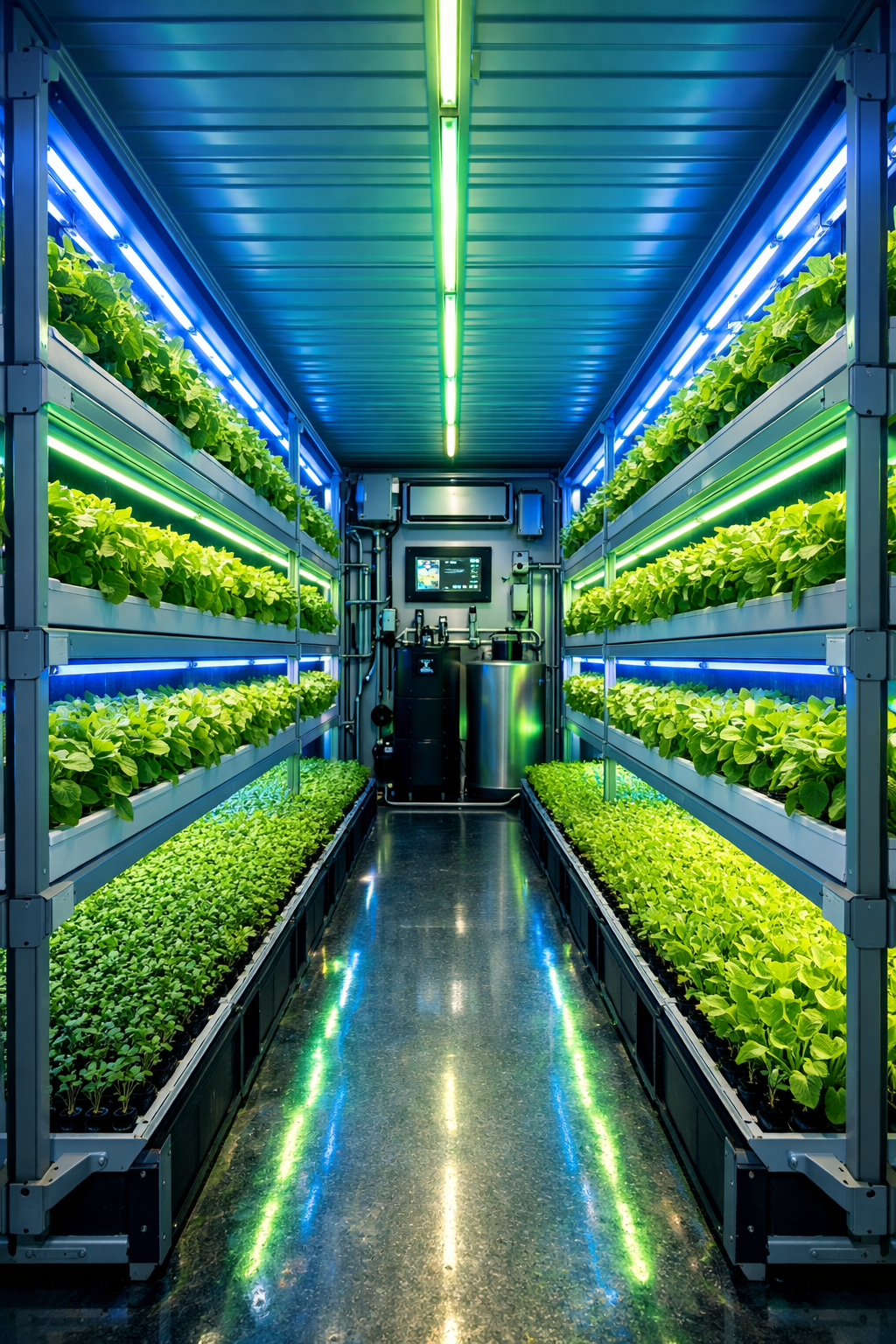
A 20-foot controlled-environment grow unit focused on leafy greens, herbs, or microgreens with predictable harvest cycles.
Biochar and heat module
A 20-foot biomass conversion unit designed to process dry feedstock into useful heat and high-carbon biochar at pilot scale.
Civil, safety, and utility infrastructure
Pads, fencing, electrical service, heat transfer hardware, moisture management, and operator safety planning complete the core pilot.
Illustrative economics
The pilot story is stronger when the economics are conservative and easy to explain.
These figures frame the MicroHub as a municipal service-backed pilot rather than a miracle machine. That is more credible to judges and more usable in real partnership conversations.
Illustrative installed pilot budget for both containers plus site work, safety, engineering, and contingency.
Illustrative annual municipal service contract, positioned as the core recurring revenue line.
Illustrative yearly produce revenue, modeled conservatively to support rather than dominate the economics.
Illustrative yearly biochar revenue at pilot utilization, before any advanced carbon-market positioning.
Funding logic
The most credible capital stack blends municipal commitment, rural infrastructure or organics funding, and partner support rather than assuming a student team self-finances a large deployment.
Commercial logic
BioLoop should be presented as a resilient public-service product with additive revenue streams, not as a venture that survives only through high-margin carbon speculation.
Success metrics
The first pilot should report simple outcomes that matter to both towns and judges.
Strong pilot metrics are memorable, measurable, and directly connected to the BioLoop story. They should show real outputs, not vanity metrics.
Track the amount of produce delivered to institutional or community partners and translate it into understandable servings or meal support.
Measure how much biomass or organics are moved away from lower-value pathways and into useful local outputs.
Use biochar output and carbon content assumptions to tell a conservative, professional carbon-storage narrative.
Partnerships
The first BioLoop pilot needs a small ecosystem of practical partners.
The venture should not pretend to do everything alone. A strong public-sector pilot is collaborative by design, and that makes the idea more professional rather than less.
Town leadership or public works
The host municipality provides the site, local legitimacy, and the central operating relationship.
Tree services, sawmills, or agricultural residue suppliers
These partners help stabilize the biomass stream and turn the waste-conversion story into an operational reality.
Schools, food pantries, grocers, or local institutions
Reliable offtake makes the food-resilience value proposition measurable and locally visible.
Extension programs, colleges, and implementation advisors
These partners strengthen training, data collection, soil-use experiments, and long-term replication credibility.
Rural development, climate, and civic funders
Blended funding improves the realism of the capex story and aligns the pilot with public-interest outcomes.
Fabrication and workforce partners
Once the pilot works, BioLoop can responsibly grow into microfactory or workforce extensions with the right local collaborators.
The launch plan gives BioLoop a believable path from idea to proof.
That is what makes the concept stronger for a deadline-driven pitch: the website now shows not only why BioLoop matters, but exactly how the first version can be structured and defended.